There is a question that stops a lot of people cold, usually around midnight. If God made everything, and God is good, then who made the devil? Did God create an enemy on purpose? Did something go wrong in heaven? Most answers you hear turn God into either the author of evil or a weak king who lost control of his own house. Both are ugly, and both come from reading the Bible as history. Read it as a map of the mind and the question dissolves: there is no second god in the book.
Look at what the word actually is. In the Hebrew of the Old Testament, satan is not a name. It is a job description. It means adversary, or accuser — the one who stands against you and states the case against you. It gets used of human opponents, of an angel blocking a road, of a prosecutor in court. Only much later did it harden into a name for a red figure with a pitchfork. The Bible never gives you that figure. Men did.
The accuser is a voice, and the voice is yours
Watch him work in the book of Job. He does not tempt Job or steal or kill with his own hands. He stands in the council and makes an argument. "Does Job fear God for nothing?" (Job 1:9). That is the whole accusation: your good man is only good because he is paid. Strip the blessings and he will curse you to your face.
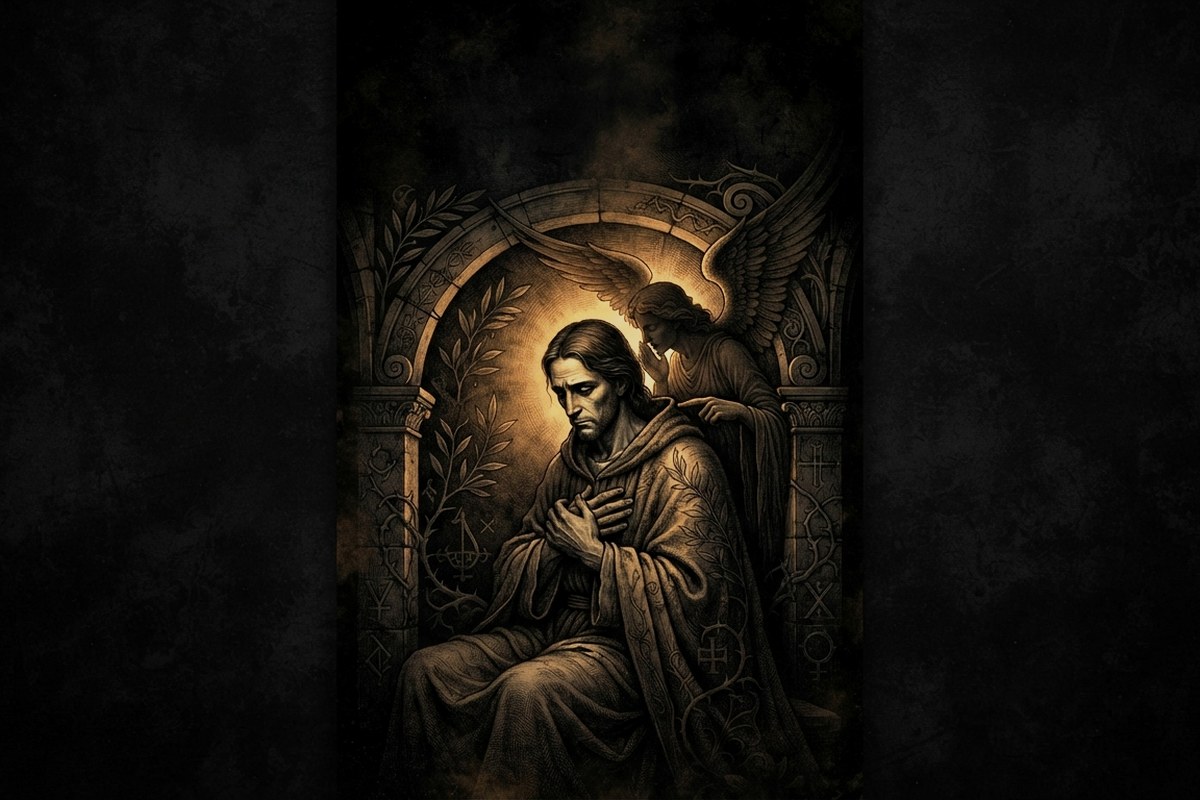
Now ask yourself where you have heard that voice. Not out in the world. Inside your own skull, at three in the morning. You only help people because it makes you feel important. You only pray because you are afraid. Your kindness is a performance. That is the accuser. He is not a fallen angel whispering from outside. He is the prosecuting mind — the part of your thinking that takes your own motives and puts them on trial.
And notice what the story does with him. He cannot act on his own. He has to ask permission. He is on a leash held by the same consciousness that holds everything else. Not a rival god. A function of mind with a limited license: permitted to test, never to destroy.
In the wilderness he questions who you are
The same voice shows up in the desert, and it opens with the same move. "If you are the Son of God..." (Matthew 4:3). Not "worship me." Not yet. First, doubt about identity. That one small word is the whole temptation.
In this teaching, Jesus is not a man who lived two thousand years ago. Jesus is imagination — the creative power of your own mind, the I AM in you that can picture a thing and bring it into being. So read the desert scene from the inside. Imagination is being tested by doubt. If you really are what you say you are, prove it. Turn this stone into bread. Throw yourself down and see if anything catches you. Each one is the mind arguing with itself about its own power.
The answer given is not a fight. It is a refusal to argue. "Man shall not live by bread alone" (Matthew 4:4). Truth answers doubt and the voice leaves — for a season, Luke adds, the most honest line in the story. It always comes back, until you stop believing it.
Anyone can step into the role
The clearest proof that Satan is a role and not a person comes from Peter. One minute he is the rock, the confession of faith, the man who names the truth. A few verses later he is pulling Jesus aside to talk him out of the cross, and he gets the hardest rebuke in the Gospels: "Get behind me, Satan" (Matthew 16:23).
Same man, same afternoon: disciple, then adversary. No demon entered him. His thinking just turned against the purpose in front of him. Satan is a position in the mind, and any thought can take that seat.
That is why the story ends where it does. The cross is the body — spine upright, arms outstretched. Crucifixion is the death of the old self: the accusing, doubting identity that has been running your life. Resurrection is the new self standing up out of it. You cannot reason the accuser to death. You have to let that self die and stop giving it a courtroom to work in.
So where did he come from?
You made him. Not on purpose, and not out of nothing — out of the same power that makes everything else, turned against itself. Fear of God became a voice that says God is watching for a mistake. Doubt about your own worth became a prosecutor who never rests his case. The Bible dresses that voice in horns and a tail so you can see it, then spends the rest of the book teaching you not to obey it.
God did not create a rival. God created a mind that can imagine — and it can imagine its own condemnation as easily as its own rising. The accuser is not out there. He is the oldest thought you have, wearing a costume. When you stop agreeing with him, he has nowhere to stand. That is not a war you win. It is a court you close.
Want to decode passages like this without getting lost?
Get the free quick-start guide: 10 Core Bible Symbols Decoded in Plain English — plus a 2-minute way to use any symbol on a hard day.
Instant PDF, plus a short weekly note. Unsubscribe any time.✦ This is only the surface ✦
Every word of the Bible carries a hidden meaning — and there is far deeper teaching in the Parallels, the full study library.
Enter the Member Library Join on Telegram