Read the Bible in order and you hit something strange. In Genesis the serpent talks a woman into a fall, and it is the bad guy of the whole story. Then in the book of Numbers, Moses puts a bronze serpent on a pole and anyone who looks at it is healed. Then Jesus refers back to that snake as a picture of himself.
Three different scenes. One animal. If the serpent meant "the devil," the third scene would be unthinkable. So the serpent is not a creature at all — it is a force in you, and the Bible shows you both ways that force can go.
What the Serpent Actually Is
The serpent is untamed desire. It is the raw, coiled energy of the lower mind — appetite, craving, the pull toward whatever promises to feel good right now. It is not evil, and it is not a talking animal. It is the most powerful drive a person has, and it is completely blind about direction.
That blindness is what makes the garden story work. The serpent does not lie about everything. It suggests. It whispers that there is more to be had, that the rule is a limit worth breaking, that you could be like God if you just reached. Nothing in that pitch is supernatural. Every one of us has heard that exact voice in the middle of the night.
Why the Fall Is Not About Fruit
The tree of knowledge of good and evil is not an orchard problem. It is the mind's fall into dual thinking — the moment you start sorting everything into right and wrong, clean and dirty, us and them. Once a mind starts living in that sorting, it cannot stop. It judges itself, then judges everyone else, then defends its judgments as though they were truth.
The serpent offered the switch. The switch was flicked. The rest of the Bible is the long climb back out.
The Same Snake, Lifted Up
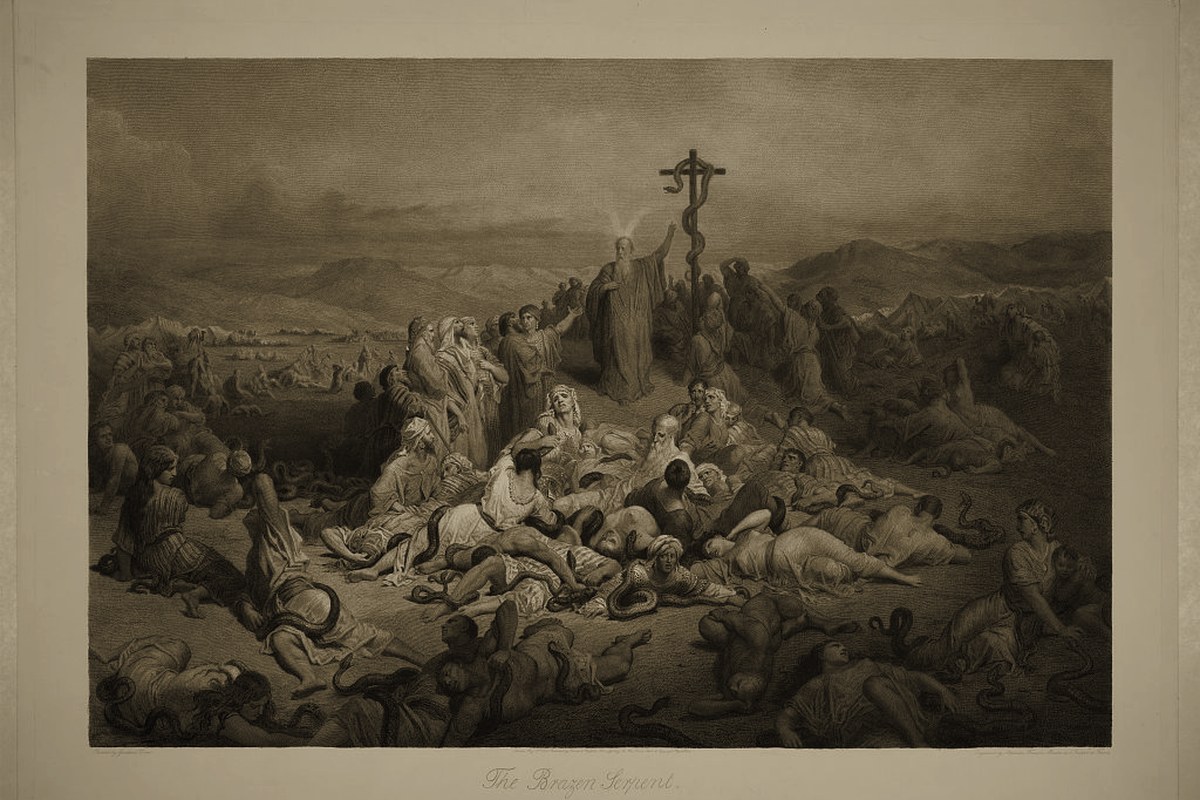
Now Numbers. Israel is bitten by snakes in the desert, and God tells Moses to make a bronze serpent and put it on a pole. Look at it, and live.
Read that as magic and it is nonsense. Read it as psychology and it is the most practical instruction in the Old Testament. The thing that bit you is the thing you have to look at. Lifted up, in the open, where everyone can see it — appetite is no longer driving from underneath. It is on a pole. You are looking at it instead of obeying it. The same energy, mastered, stops wounding and starts healing.
That is why Jesus points back to it. He says the son of man must be lifted up the same way. He is describing the pattern: what is raised into the open stops ruling from the dark.
What This Means Day to Day
You cannot remove desire. People have tried, and the ones who suppress it hardest end up the most dangerous. The Bible never asks you to kill the serpent. It asks you to lift it.
Practically, that means naming the craving instead of arguing with it. "I want this, and I want it now" said out loud is a serpent on a pole. The same sentence swallowed and obeyed is a serpent in the garden. Nothing changed but the elevation.
The Two Questions Worth Asking
When a strong pull shows up, ask two things. What is this energy actually for? And who is holding it?
Untamed, it eats the mind that feeds it. Lifted, it becomes wisdom — the sharp, warm, alive thing in a person who has stopped being run by their appetites and started being informed by them. The Bible keeps the same animal in both stories on purpose. It is not telling you the snake is evil. It is telling you the snake is yours.
✦ This is only the surface ✦
Every word of the Bible carries a hidden meaning — and there is far deeper teaching in the Parallels, the full study library.
Enter the Member Library Join on Telegram